iPhones Update
PTA Approved vs Non-PTA vs JV iPhone: Which Should You Buy?
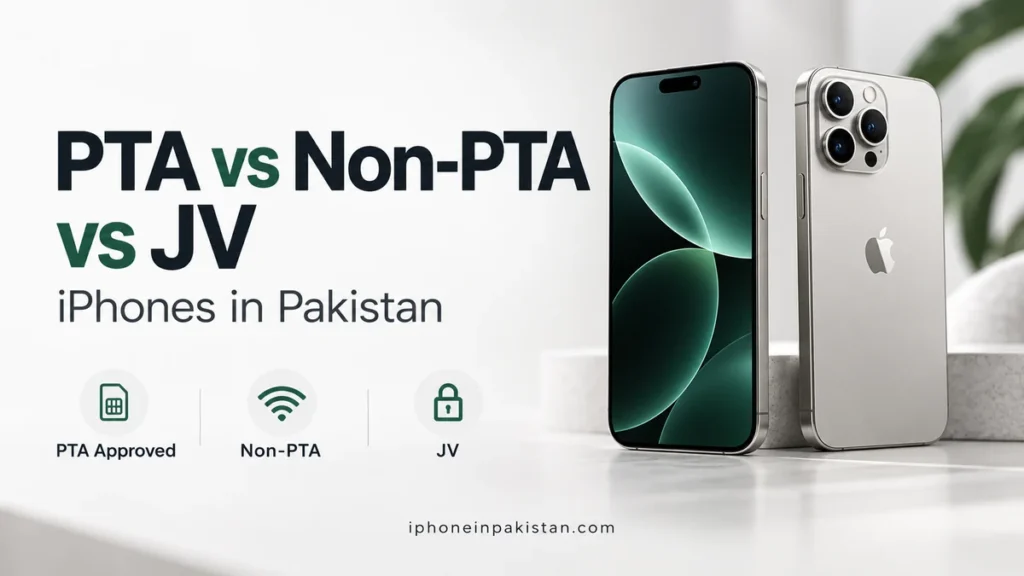
It can be confusing to purchase an iPhone in Pakistan, as the same model can have a completely different price depending on whether it is PTA-approved, non-PTA, or JV. While a lower price can be appealing, it often does not mean you are getting the better overall deal.
The real question is not how much the iPhone costs. This clears your doubt about whether you can use a Pakistani SIM on this phone, whether the device has any carrier lock, whether its IMEI is registered, or if there are some other restrictions on your phone.
A PTA-approved iPhone is usually going to be the simplest choice for a person looking for some full-on cellular functionality in Pakistan. A non-PTA iPhone may seem cheaper when bought, but the buyer must have clarity on its registration and network limitations. Over in Pakistan, however, a JV iPhone is frequently used to describe devices that are tied to carrier restrictions or other limitations in the local second-hand smartphone market. JV is not an actual Apple product category.
This guide helps you to understand PTA-approved vs. non-PTA vs. JV iPhones in real terms. You learn how these categories differ from each other, what to check before buying, and which one makes sense under your budget and usage per day.
What Is a PTA-Approved iPhone?
A PTA-approved iPhone is one whose identification status, along with the device registration status, would allow it to be used within Pakistan under the regulatory system in place.
Why PTA approval is important: Just because an iPhone can be registered as a device does not mean that it will work as a locally registered cellular network device. These are two separate things. A phone can work normally with Wi-Fi, cameras, apps, Bluetooth, and other features working fine, while for its local cellular connectivity, it relies on its registration. Check each iPhone PTA Tax here.
Pakistan employs a system called the Device Identification Registration and Blocking System, or DIRBS, to identify what it considers compliant versus non-compliant mobile devices operating on its networks. The registration and applicable duties or taxes are part of the regulatory framework regulated through Registered Government Systems.
The crucial piece for buyers, however: do not rely on a seller simply claiming “PTA approved.” However, always verify the actual IMEI and registration status via official methods before purchasing the handset.
Such as in the case where you’re purchasing a second-hand iPhone. Checking a seller’s title on the listing, a WhatsApp message, a printed receipt, and a screenshot shouldn’t be your substitute for independent verification.
For a person who intends to stick a Pakistani SIM into the iPhone and not let the registration status of that phone be an everyday headache, Apple’s PTA-approved iPhones usually become the easiest solution in mind, as these phones can then use cellular calls, SMS, mobile data, and other network services.
Check our PTA-approved iPhones.
What Is a Non-PTA iPhone?
More broadly, “non-PTA” refers to the iPhone not being currently enrolled with Pakistan’s device-registration system for use with normal local cellular networks.
Many reasons Non-PTA iPhones are popular across Pakistan, one of which is the relatively lower resale price. PTA-approved phones do not account for this, and it allows buyers to get newer or even higher-spec iPhone models at prices often significantly lower than for comparable PTA-approved devices.
A Non-PTA iPhone also works over Wi-Fi as usual. Your apps, web browsing over Wi-Fi, photos, and video—all your standard everyday tasks run on Bluetooth devices now.
The biggest issue is cellular connectivity on Pakistani networks. The fact that not every non-PTA phone can still use local cellular services indefinitely needs to be understood by the buyers rather than assumed.
And this is why a non-PTA iPhone can be a great deal for someone and absolutely terrible for someone else. If you have another PTA-compliant phone for calls and mobile data, it does make more sense to pick up a non-PTA iPhone as a secondary device. The constraints become far more serious if the iPhone will be your sole phone.
Check our NON-PTA iPhones.
What Is a JV iPhone?
In Pakistan, “JV iPhone” is a term that sellers and buyers use for used iPhones. It is not an official product category from Apple. For domestic usage, JV sometimes refers to an iPhone that was previously on the roster of a foreign carrier or has some carrier-locking feature. That being said, the term is often misused in the market, so never assume every phone advertised as JV has the same specs. JV and Non-PTA represent different things when it comes to a phone, and this is the key difference.
Non-PTA only indicates that the phone has never been registered on a Pakistani network. JV is usually an indication of carrier-related lockouts or a specific imported used device. This means a phone can also be non-PTA and carrier-locked simultaneously.
For instance, if two of your imported iPhones are non-PTA. At least one would be factory unlocked and able to take compatible SIMs once its problematic Pakistani registration was handled. The other might be limited to one carrier. Not keeping both phones equally the same just because they are non-PTA would be unfair. Must check our what is JV iPhone guide for a better understanding.
Note: The precise carrier status must be verified on the iPhone itself. Hence why when a seller says “JV hai,” it is doubly irrelevant. Inquire what carrier lock exists, whether the phone is unlocked nowadays, does it have any different restrictions, and does the dealer provide return coverage?
Check our JV iPhones.
PTA-Approved iPhone vs. Non-PTA and JV iPhone
PTA approved vs. non-PTA vs. JV iPhone HELP: This is better understood if you look at the issues separately and do not compare terms used in Apple to something like an official Apple category.
Feature
- PTA Approved
- Non-PTA
- JV
Local SIM usage
- Typically enabled if device and SIM are otherwise compatible
- It depends on the registration status and applicable rules
- Based on PTA status and carrier status
PTA registration
- Registered/compliant status should be verified.
- Typically unregistered for non-commercial home use
- Might also be Non-PTA; cross-verify separately
Typical price
- Usually higher
- Often lower
- Often lower
Wi-Fi usage
- Normal
- Normal
- Generally normal, depending on the condition of the device
Carrier restrictions
- Checked the same way you would on any iPhone
- May be unlocked or locked
- Carrier restrictions are a major concern.
Resale considerations
- Usually easier for everyday local buyers
- More limited buyer pool
- Restrictions can make it more difficult.
Best suited for
- Primary-phone users
- It’s buyers who know the precise limitations.
Main disadvantage
- Higher total cost
- Cellular limitations may apply.
- Carrier limitations and additional purchasing difficulty
Use the table as a guide for when to buy, not as a hard and fast rule. A given iPhone’s IMEI status, carrier-lock status, model, condition, and history all can affect the practical outcome.
PTA Approved vs Non-PTA iPhone
One of the most noticeable real-world differences between a PTA-approved and non-PTA iPhone is local cellular connectivity. For a user that relies on a Pakistani SIM daily, this will almost certainly be the easier choice: A PTA-approved iPhone. If your phone is stolen, you care about the phone and are not worried as to whether it is registered or not.
An iPhone without the price of a phone for non-PTA users. That savings could also be helpful if you plan to utilize an additional mobile phone for cell coverage or simply use the iPhone at home, work, or other locations with superior Wi-Fi.
The trade-off is convenience. A mobile data user throughout the day, a caller on an iPhone, or a frequent traveler who prefers the phone to function independently as its primary device are less enamored by the lower Non-PTA price.
Resale is another consideration. PTA-approved phones draw more local customers for immediate daily cellular use. A non-PTA device can appeal to buyers looking for an imported iPhone model at a comparatively lower price. Thus, while comparing PTA vs. non-PTA iPhones, compare only the prices at which you buy. Compare the total ownership experience.
Non-PTA vs JV iPhone
An iPhone, which is a non-PTA device, only indicates something about whether this iPhone has been registered by the corresponding Pakistani network. It will not immediately let you know if the iPhone is carrier locked.
The word “JV” means a device that comes with a carrier-related launch or limitation in the domestic market. The precise definition may differ among vendors, which is why the physical device needs checking.
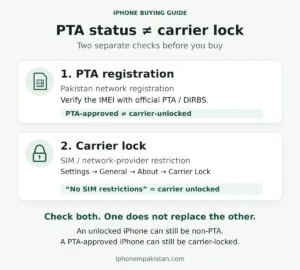
Remember, a consumer should never treat a non-PTA factory-unlocked iPhone as equivalent to a JV/carrier-locked iPhone. Consider the following situation. You Then Come Across an Imported Non-PTA iPhone at a Low Price You check Settings → General → About → Carrier Lock and see “No SIM restrictions” before purchasing. That provides you with information about the carrier status, but it does not make that a PTA-approved phone.
Other phones could be flagged as JV and also may show some sort of carrier lock or a block. Perhaps the limited spec is reflected in a lower price? The takeaway is straightforward: check the iPhone PTA status and also the carrier lock. One does not supersede the other.
PTA Approved vs JV iPhone
iPhones approved by the PTA are typically tailored for everyday local cellular use, one that most Pakistani buyers would expect. The buyer also needs to understand just how restricted a JV iPhone is from their carrier and whether the money saved in buying that phone is worth the price of a bypass.
Restrictions can be maddening to the person who uses one phone for calls, OTPs from banks, mobile data, messages, and navigation ON THE ONE HAND and WORKS ON THE OTHER.
If you already have another PTA-compliant phone, the use case for a much lower-cost iPhone to almost exclusively function as a Wi-Fi, photo capturing, media consumption, and gaming or even secondary phone sounds good in very select situations—JVs may make sense.
But that lower price should not simply be considered a steal. Carrier restrictions can make SIM usage, troubleshooting, reselling, and future unlocking tricky. This is why the PTA-approved vs. JV iPhone choice should depend on your actual use, not on the difference in label price.
How to Check an iPhone for PTA Approval
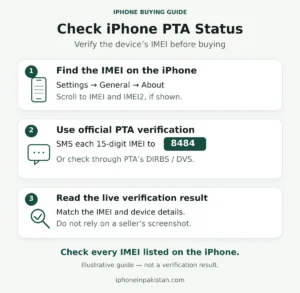
Always check the device’s IMEI and registration via official PTA/DIRBS before purchasing.
Do not depend only on:
- The seller’s verbal claim
- A WhatsApp screenshot
- A marketplace listing
- A printed sticker
- The same is observable in another device owned by another individual.
To verify, enter the IMEI into the tool—make sure that it has been correctly copied from the iPhone and pertains to the device being sold if we are looking at a used phone.
The best way to verify this is through the service itself, not relying on a seller-provided screenshot as proof.
Also note, PTA approval does not speak for the phone. However, an iPhone approved as PTA-compliant can still be carrier-locked with Activation Lock, or have bad battery health, or even have some replaced parts or restrictions.
How to tell whether your iPhone is JV or carrier-locked
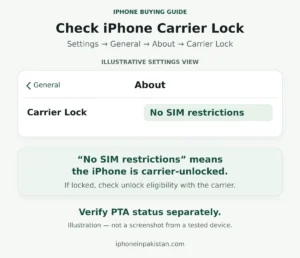
Apple offers a quick solution that checks carrier-lock status directly from the iPhone.
Go to:
Go to Settings → General → About and scroll down to Carrier Lock
But if the device indicates a restriction relating to a carrier, you will want to check into it before buying.
This verification is way more valuable than quickly checking the word “JV” in a seller’s posts. Request the seller to allow you to scrutinize the real device. Always test with your own SIM-compatible phone where possible, and the phone behaves as expected.
Carrier lock is also distinct from the Pakistani PTA registration problem. The carrier unlocked the iPhone, but the Non-PTA was activated. Or it can have other unique problems too, never being any of those two categories. That difference could save you from purchasing the wrong phone.
How to Inspect a Used iPhone Before You Buy It
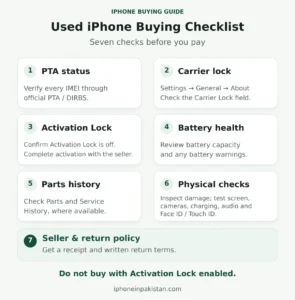
If you are buying a used iPhone, it is not only about the model and storage. Start with the physical condition. Check for cracks, dead pixels, touch issues, odd brightness discrepancies, or evidence of a swap on the screen. Inspect the Frame & Back Glass. Check for major damage
Battery health is also important. Head over to Settings → Battery → Battery Health and check the information available. That does not necessarily mean an iPhone with lower battery capacity is a bad buy, but you need to be aware of it; it should be reflected in the price and also in what you expect.
You need to check whether the battery or any parts have also been changed.
Apple better tracks Parts and Service History under Supported iPhones.
Settings → General → About
The phone may tell you when parts have been replaced, depending on the model/IOS. Apple also clarifies that a part can be recognized as genuine or, in certain situations, as unknown.
On an iPhone locked to the owner, do not purchase the device. This is important because the previous owner must remove their Apple Account properly before you take possession.
Ask the seller to factory reset the iPhone and begin setting it up in front of you—if possible. Specifically, if during the setup you are asked for the Apple Account of the previous owner, remember that the device is still linked to her account. Finally, check Carrier Lock separately. An Activation Lock-cleared phone does not equal a carrier-unlocked phone. Check our things to heck before buying a used iPhone guide.
Can a JV iPhone Be Unlocked?
This means buyers need to be wary about sellers touting a guaranteed “permanent JV unlock” without full disclosure on what is being changed and who exactly is authorizing the unlock. Steer clear of dubious unlocks, unofficial mods, or ways that could cause future headaches.
For you buying a carrier-locked iPhone: have the current status with the carrier treated as part and parcel of your purchase. Don’t pay more just because someone says it will definitely get unlocked later.
Pros and Cons of PTA Approved iPhones
Advantages
The biggest advantage is convenience. A PTA-approved iPhone is aligned to someone who plans to use a Pakistani SIM due to the regular usage of cellphones.
This is also an easy path for purchasers who intend to use the device for a few years and don’t want future registration to become an ongoing headache.
Since the buyer isn’t faced with the same registration question prior to using the phone, PTA-approved devices can also be simpler and easier to market further down the line.
Disadvantages
The main disadvantage is cost.
Ultra-high unique Davis the PTA approval if to purchase it most are high or near a PTA-free import wherein calculated obligations see?
Buyers should check the official details rather than taking a decades-old tax figure from a social post at face value, as these charges can change and also vary depending on device and registration situations.
Non-PTA iPhones: Pros and Cons
Advantages
Its biggest draw is the lower initial cost.
An iPhone can be used with non-PTA. It makes sense for a person on a budget who needs an up-to-date model of the device and who is okay using Wi-Fi or another phone and considers cellular usage.
It could also serve as a gaming and photography/video editing/media consumption (or any other function that would not require continuous access to cellular service in Pakistan) secondary device.
Disadvantages
The biggest drawback is the restrictions on broadband data connections available locally.
Then there is the issue of registration requirements. Buyers need to work out which rules apply before buying, rather than assuming that the current capabilities of an always-connected phone will remain valid forever.
The trade-off of convenience may be worth more to the person who needs a single phone for everything than the upfront saving.
Pros and Cons of JV iPhones
Advantages
Price is often the main attractive point of a JV iPhone. The lower cost is sometimes reasonable for one who thoroughly understands the carrier status of the device and has a very specific use case they want to consider for secondary-device applications.
Based on the individual device (commercial unit), a JV iPhone is capable of working great for Wi-Fi-dependent uses like apps, gaming, photography, video, and streaming.
Disadvantages
The largest concern is imposed by carrier restrictions.
It could be that the phone has certain limitations a buyer did not expect, and seller terminology may make those limitations challenging to parse.
This can make resale easier, although it may also be more complex since some buyers even look for carrier-locked or JV devices.
So the only obvious trade-off is a lower price, but there are possible added limitations and ownership complexity.
Which iPhone Should You Buy?
It all depends on how you actually use your phone.
Choose PTA-approved if:
- You want the simplest day-to-day experience you could get.
- You frequently use a number from Pakistan.
- The iPhone will become your main phone.
- Your mobile data reliance.
- You want fewer registration-related concerns.
- You intend to hold onto that phone for a few years.
Choose Non-PTA if:
- Your budget is limited.
- You are aware of the network and registration restrictions placed on you.
- You primarily use the phone when it is connected to Wi-Fi.
- You have another phone for cellular service.
- The price saving was sufficiently significant that it justified the restrictions.
Consider JV only if:
- You know what exactly the seller means by JV.
- You verified the carrier lock yourself.
- You understand the SIM limitations.
- You have verified the PTA status of the device individually.
- You accept the risk of future resale or warranty.
- A decrease in price is necessarily warranted based on your consumption.
- Do not pick JV just because it is the cheapest option.
PTA Approved vs. Non-PTA vs. JV—Which Is Best for You?
Here is the simplest decision guide:
Your Priority
- Better Fit
- Least hassle
- PTA Approved
- Regular Pakistani SIM use
- PTA Approved
- Lower upfront price
- Non-PTA
- Mostly Wi-Fi use
- Non-PTA
- Secondary iPhone
- Non-PTA or JV, depending on restrictions
- Lowest possible purchase price
- JV may be cheaper, but verify carefully.
- Carrier-free ownership
- Check for “No SIM restrictions.”
- Long-term primary phone
- PTA Approved is generally the safer convenience choice.
The important warning is that these labels are not enough by themselves. A seller may use “JV,” “factory unlocked,” “non-PTA,” or similar terms differently. Always inspect the actual device and verify its individual status.
Common Mistakes to Avoid When Buying a JV or Non-PTA iPhone
Mistake 1: Buying because it looks cheap. One of those “cheap” iPhones can lead you to end up spending a lot more if it has some restrictions you didn’t know about. Another common mistake is assuming that Non-PTA and JV are the same. They do not. PTA registration is a separate check than carrier lock. Always do a carrier lock check (NEVER LU, NEVER). Go to Settings > General > About and check the Carrier Lock.
Do not ignore activation lock. Do not buy the device if it indicates “iPhone Locked to Owner.” You must cross-check the IMEI and PTA status by yourself instead of relying on a seller’s screenshot. Don’t overlook parts and service history. The phone might still function if parts are replaced or added, but you need to know what it is that you’re buying. Be careful with permanent-unlock promises. Carrier-unlocking policy while carriers are “sorry, that’s what the current carrier has to do,” and Apple insists.)
Frequently Asked Questions
What is the difference between PTA and non-PTA iPhones?
An iPhone registered with a PTA code is considered admissible for use on Pakistan’s local mobile networks. Normally, a non-PTA iPhone is not on the registration-based list according to local registration. The device itself will work perfectly fine other than this.
What is JV on iPhone in Pakistan
Another thing in the market is the term “JV,” mostly used for some imported or carrier-related iPhones. It is not part of any Apple product line, strictly speaking. The precise restrictions vary depending on the device, so check for a carrier lock instead of relying on the label.
Is the JV iPhone safe to buy?
Safe, sure, but remain aware of the limitations that some buyers will have to work around to get actual use from their device. Be sure to check Activation Lock, Carrier Lock, PTA status & parts history, battery health, and physical condition before you buy.
Can we use a Pakistani SIM in a JV iPhone?
It is dependent on the status of both the carrier and PTA for that device. Carries locked to iPhones may be limited to their carrier, as Pakistani network registration is separate.
Is Non-PTA better than JV?
Neither is automatically better. It might be easier to purchase an unlocked Non-PTA factory-unlocked iPhone via a carrier than a JV device, but the actual status of the device is more pertinent as compared to its label.
Can a non-PTA iPhone be made PTA-approved?
In such a case, the non-PTA device can be registered with the relevant Pakistani process. The buyer needs to verify the official specifications for that specific device and what charges may apply.
What does “iPhone No SIM lock” mean?
From the carrier side of things, it means an iPhone is technically unlocked and able to work with other compatible carriers.
Should I get a PTA-approved or non-PTA iPhone?
Buy PTA-approved if you want real Pakistani cellular service with the least hassle. Get Non-PTA if it matters, and the restrictions apply.
Can I unlock a JV iPhone permanently?
Do not assume it can. Apple says that it is up to the current carrier to unlock a carrier-locked iPhone. Be suspicious of any seller that claims they can permanently unlock your device.
Is the JV iPhone non-PTA?
No. Non-PTA is purely dependent on the registration of the Pakistani network, and “JV” is a market term related to carrier restriction for ease of reference only. Non-PTA and carrier-locked phone
Final Verdict
When it comes to PTA-approved vs. non-PTA vs. JV iPhones, there is no one-size-fits-all solution for the Pakistani buyer. For daily no-fuss usage, a PTA-approved iPhone is generally the most sensible option if you can afford it. It is particularly ideal when you are using the iPhone as your only phone and rely on a Pakistani SIM to receive calls, messages, mobile data, and other daily services.
If we see the limitation, a non-PTA iPhone can be a good value option. It might be appropriate for buyers who primarily rely on Wi-Fi, have access to another phone with cellular service, or simply wish to save some cash up front.
JV iPhones need the most thorough checks. The price can be enticing, but you also have to know what the seller means by JV and whether that specific device has a carrier lock. Do not believe that a JV phone can be unlocked sometime later by itself.
Find IMEI/PTA status, carrier lock, activation lock, parts and service history, battery condition, physical condition, and seller return policy before sale. So, not the cheapest iPhone is the best iPhone we’ve ever made. To be the vehicle your restrictions allow you to operate and needs to be registered, insured, and maintained according to how you intend to use it—and costs an amount that only a large number of folk could ignore.
