iPhones Update
Reality of Non Custom Phone
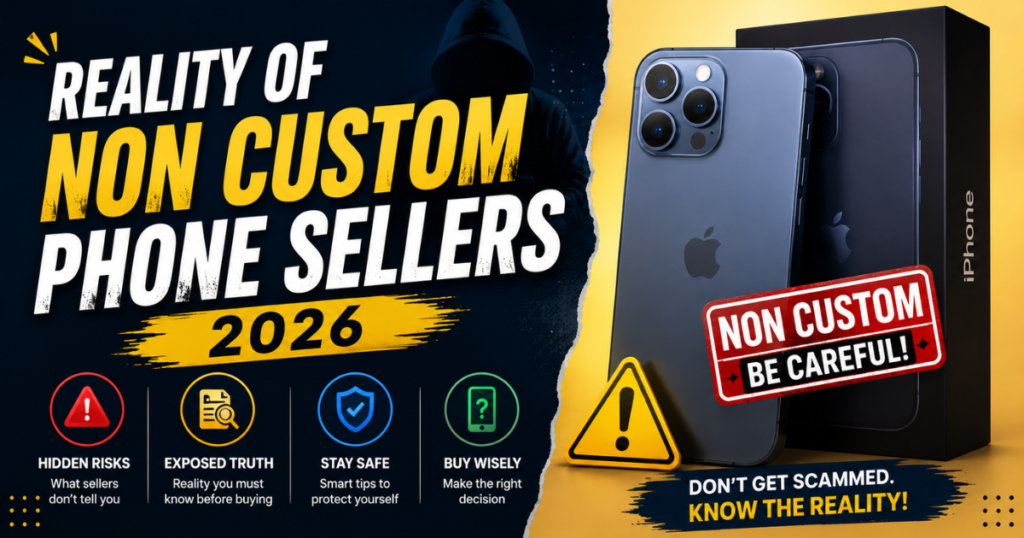
Have you ever heard of a non-custom iPhone? If yes, then let’s understand what this new scam is and the reality of a non-custom iPhone. Buying an iPhone is hard specially the latest one, so scammers keep returning with new ideas to loot people. Because of rising prices and PTA taxes in Pakistan, many buyers look for cheaper alternatives online. While searching on Facebook Marketplace, WhatsApp groups, TikTok, or local buying and selling pages, you may have seen advertisements claiming to sell “non-custom phones” at unbelievably low prices.
These advertisements often promise the latest iPhone models at almost half the market price. At first glance, these offers look attractive, especially for students and people trying to save money. Unfortunately, many of these listings are designed to deceive buyers rather than help them find a genuine deal.
One of the biggest misconceptions is that there is a special category called a “non-custom phone.” In reality, no official authority recognizes this term. Unlike imported vehicles, smartphones are not sold under a legal “non-custom” category. Most scammers use this phrase simply to attract attention and convince buyers that they are getting an exclusive bargain.
This guide explains the complete reality behind non-custom phone sellers. You will learn how these scams work, why the term “non-custom phone” is misleading, and how you can protect yourself before spending your hard-earned money.
What Is a Non-Custom Phone?
The first thing every buyer should understand is that “non-custom phone” is not an official smartphone category. It is simply a marketing phrase that many online sellers use to attract customers.
Many people mistakenly believe that a non-custom phone means a phone that entered Pakistan without paying customs duty but can still be used normally. Others think it is similar to imported cars that have different customs statuses. This assumption is incorrect.
In Pakistan, smartphones are generally classified based on their PTA registration status, not as “custom” or “non-custom” phones.
Usually, you will find only two common categories:
- PTA Approved Phones – Devices that can use all Pakistani SIM cards without any issue.
- Non-PTA Phones – Imported devices that require PTA registration and tax payment before permanent SIM usage.
There is no official government category called a “non-custom phone.”
Unfortunately, many inexperienced buyers do not know this difference. Scammers take advantage of this confusion by advertising “non-custom” devices at impossible prices to create excitement and urgency.
Does a Non-Custom Phone Really Exist?
The simple answer is no.
There is currently no official organization in Pakistan that classifies smartphones as “non-custom phones.” Whether you purchase an iPhone, Samsung Galaxy, Google Pixel, or any other smartphone, the important factor is its PTA status.
Many buyers become confused because they compare smartphones with imported vehicles. Cars may have customs-related documentation, but smartphones follow an entirely different import and registration process.
For example, if someone advertises the following:
- iPhone 16 Pro Max
- Non-custom
- Brand New
- Only PKR 95,000
This advertisement should immediately raise questions.
If the actual market price is significantly higher, you should ask yourself why someone would willingly sell a genuine flagship phone at such a huge loss.
In most situations, there are only a few possibilities:
- The advertisement is fake.
- The phone does not exist.
- The seller plans to scam buyers through advance payments.
- The photos were copied from another website or social media page.
Understanding this simple fact can save you from losing a significant amount of money.
Why Do Sellers Use the Term “Non-Custom Phone”?
If the term is not real, why do so many advertisements use it?

The answer is simple.
Because it attracts attention.
When buyers see expensive iPhones listed at extremely low prices, curiosity naturally increases. Many people think they have found a hidden opportunity before anyone else.
Scammers understand basic human psychology very well.
Instead of writing “fake iPhone” or “cheap imported phone,” they use phrases like:
- Non-custom iPhone
- Duty-Free iPhone
- Direct Imported Phone
- Fresh Stock
- VIP Imported Device
- Airport Clearance Phone
These phrases sound professional even though they have no official meaning. The goal is to make buyers believe they are getting access to a special deal unavailable in normal mobile markets. Another reason scammers use this tactic is that buyers often focus only on price instead of verification.
For example, imagine two advertisements.
Seller A offers an iPhone 16 Pro Max for its normal market value. Seller B offers the same phone for nearly half the price while claiming it is a “Non Custom Phone.” Many buyers immediately contact Seller B because everyone likes saving money. This emotional decision often becomes the first step toward losing that money.
How Fake Non-Custom Phone Scams Work
Most fake sellers follow almost the same pattern.
Once you understand their process, it becomes much easier to recognize suspicious advertisements.
Step 1 – Attractive Advertisement
Everything begins with an unbelievable offer.
The seller uploads high-quality pictures of expensive iPhones and writes attractive captions such as:
- Limited Stock
- Urgent Sale
- Imported Non-Custom iPhones
- Lowest Price in Pakistan
- Original Box Pack
- Delivery Available Nationwide
These advertisements usually receive hundreds of comments because people become excited by the low prices.
Sometimes scammers even copy photos from official Apple advertisements or genuine online stores.
Step 2 – Building Trust
After you send a message, the seller behaves very professionally.
They reply quickly.
It sent additional pictures.
They may even share fake CNIC images, fake shop photos, or edited customer reviews.
Some scammers create WhatsApp Business accounts to appear more trustworthy.
Others use fake Facebook pages with thousands of purchased followers.
Everything is designed to convince you that they operate a genuine mobile business.
Step 3 – Advance Payment Demand
This is where the actual scam usually begins.
The seller says one of the following:
- Advance payment required for booking.
- Pay delivery charges first.
- Transfer 30% before dispatch.
- Stock is limited.
- Payment confirms your order.
Many buyers think paying a small booking amount is safe.
Unfortunately, once the payment is transferred, communication often changes immediately.
Step 4 – Disappearing After Payment
After receiving the advance amount, scammers may:
- Stop replying.
- Block your phone number.
- Delete the Facebook page.
- Disable WhatsApp.
- Remove the advertisement completely.
Some buyers never receive any package.
Others receive an empty parcel or a completely different product.
Recovering the money becomes almost impossible because fake sellers often use temporary bank accounts or digital wallets opened using stolen identities.
Common Tricks Used by Fake Sellers

Not every scam looks the same.
Experienced fraudsters constantly change their methods to fool more people.
Below are some of the most common tricks buyers should know.
Unrealistically Low Prices
This is the biggest warning sign.
If every trusted mobile shop is selling an iPhone for PKR 300,000 but someone offers it for PKR 120,000, you should immediately question the advertisement.
Remember:
If an offer sounds too good to be true, it usually is.
Fake Customer Reviews
Many scam pages upload edited screenshots showing satisfied customers.
These reviews can easily be created using image editing software.
Never trust screenshots alone.
Always check independent reviews and seller history.
Fake Courier Receipts
Some scammers generate fake tracking slips after receiving payment.
They tell buyers the parcel has already been shipped.
Days later, buyers discover the tracking number never existed.
Stolen Product Photos
Many advertisements use pictures copied from YouTube reviews, Apple websites, or genuine online stores.
Moreover, just because the photos look professional does not mean the seller actually owns the phone.
Therefore, a reverse image search can often reveal where those images originally came from.
Fake Shop Addresses
Some sellers claim they have physical stores in Lahore, Karachi, or Islamabad.
When buyers ask for a visit, they suddenly make excuses such as:
- Shop under renovation.
- Warehouse delivery only.
- Staff unavailable.
- Appointment required.
These excuses are often used to avoid face-to-face meetings.
Why Buyers Fall for These Scams
Many intelligent people become victims of these scams because fraudsters understand how emotions influence buying decisions.
The biggest reason is greed mixed with urgency.
When someone believes they have found a rare opportunity to buy an expensive iPhone for a fraction of the normal price, however, logical thinking often disappears.
Additionally, another common mistake is trusting social media appearances.
A Facebook page with thousands of followers or a WhatsApp Business profile does not automatically mean the seller is genuine.
Furthermore, scammers know how to create professional-looking profiles within a few hours.
Moreover, people also make the mistake of sending small advance payments, thinking, “It’s only a booking amount.”
Unfortunately, this small payment is exactly what the scammer wants.
How to Identify a Fake Non-Custom Phone Seller
Before buying any expensive smartphone online, always verify the seller carefully.
Some simple checks can protect you from losing thousands of rupees.
- Always compare the market price before contacting the seller.
- Never trust advertisements offering unrealistic discounts.
- Avoid paying any advance payment to unknown sellers.
- Ask for a live video call showing the actual phone.
- Verify the IMEI number before making any payment.
- Prefer face-to-face deals whenever possible.
- Buy from well-known mobile markets or trusted retailers instead of anonymous social media accounts.
Check whether the seller has genuine long-term customer reviews instead of edited screenshots.
Difference Between a Non-PTA Phone and a “Non-Custom” Phone
One of the biggest reasons buyers become victims of online scams is that they do not understand the difference between a non-PTA phone and a so-called “non-custom phone.” Many scammers intentionally mix these terms to confuse people and make fake advertisements look genuine.
A Non-PTA phone is a real category. These are imported smartphones that have not yet been registered with the Pakistan Telecommunication Authority (PTA). Such phones can usually be used for a limited time with a Pakistani SIM card, but after that period, they must be registered by paying the required PTA tax.
On the other hand, a “non-custom phone” is not an official category. No government department, customs authority, or PTA recognizes this term. It is simply a marketing phrase that many fake sellers use to attract buyers.
This is where many people make a costly mistake. They assume that a non-custom phone is similar to a non-PTA phone, but these are completely different things.
Quick Comparison
| Non-PTA Phone | “Non-Custom Phone” |
| Officially recognized status | No official existence |
| PTA registration required | No legal meaning |
| Can become PTA-approved after tax payment | Usually used in misleading advertisements |
| Sold by genuine retailers | Commonly used by scammers |
Whenever you see the words “Non-Custom iPhone” in an advertisement, do not assume it is a legitimate product. Instead, verify exactly what the seller is offering.
Real Scam Case Study

During the past few years, I have reviewed dozens of online smartphone advertisements and spoken with buyers who lost money through fake mobile listings. Although every case is slightly different, the scam pattern remains almost the same.
One buyer found an advertisement for an iPhone 16 Pro Max on Facebook Marketplace. The seller claimed the phone was “non-custom,” factory sealed, and available for almost half of the normal market price.
The seller appeared trustworthy. He shared professional product photos, screenshots of customer reviews, and even a fake business registration certificate. After several conversations, he requested a booking amount to “reserve the last available unit.”
The buyer transferred the money.
Within a few hours, the seller stopped replying. The Facebook page disappeared, the WhatsApp number became inactive, and the buyer never received the phone.
Unfortunately, this story is not unique.
Scammers repeat the same strategy with hundreds of buyers every month because attractive prices make people ignore obvious warning signs.
The biggest lesson from cases like this is simple:
Never send advance payment to an unknown online seller simply because the price looks attractive.
How to Buy an iPhone Safely in Pakistan
Buying an expensive smartphone online is not always dangerous, but you must follow a few important safety rules.
Buy From Trusted Sellers
Always purchase your phone from a well-known retailer, an authorized Apple reseller, or a reputable mobile shop with a physical location. Or, if you plan to buy online, cross-check everything, then make any decision. Stores like iPhoneinPakistan are great for online trust.
Established businesses have reputations to protect, making them far less likely to disappear after receiving payment.
Verify the PTA Status
Before buying any iPhone, ask the seller whether the device is PTA-approved or non-PTA.
Request the IMEI number and verify its status yourself instead of relying only on the seller’s claims.
Meet the Seller in Person
Whenever possible, arrange a face-to-face meeting.
Inspect the phone carefully before making any payment.
Check:
- Display condition
- Camera quality
- Face ID
- Battery health
- Speakers
- Charging port
- SIM functionality
- IMEI number
A few minutes of inspection can save you from a very expensive mistake.
Never Pay Full Amount in Advance
This is one of the most important rules.
Genuine businesses rarely ask strangers to transfer the full payment before seeing the phone.
If a seller keeps insisting on advance payment, booking charges, or reservation fees, treat it as a warning sign.
Compare Prices First
Before buying any iPhone, compare prices from several trusted mobile stores.
If one seller offers the same phone at an unbelievably low price, ask yourself why.
Legitimate businesses cannot sell genuine flagship phones for half of their actual market value.
Warning Signs You Should Never Ignore
Scammers often leave clues that buyers overlook because they become excited about the low price.
Here are some major warning signs.
Extremely Low Prices
If the deal looks impossible, it probably is.
No genuine seller wants to lose thousands of rupees without a reason.
Pressure to Buy Quickly
Fraudsters often say:
- Only one phone left.
- Offer ends today.
- Another customer is waiting.
- Pay now to reserve your unit.
These tactics create panic so buyers stop thinking carefully.
Refusing Video Calls
If the seller refuses to show the actual phone during a live video call, you should become suspicious immediately.
A genuine seller normally has no problem showing the device.
No Physical Shop
Many fake sellers claim they operate online only.
Some even provide fake addresses that do not exist.
If a seller cannot prove they have a real business location, proceed carefully.
Only Advance Payment Accepted
When every payment option requires sending money first, it is usually a bad sign.
Reliable businesses often provide secure payment methods or allow payment after inspection.
Should You Buy a Phone Advertised as “Non-Custom”?
In most situations, the safest answer is no.
The problem is not simply the wording.
The real issue is that the phrase has no official meaning.
If someone advertises a “Non-Custom Phone,” ask detailed questions instead.
For example:
- Is the phone PTA approved?
- Is it officially imported?
- Can you provide the IMEI number?
- Can I inspect the phone before payment?
- Is there any warranty?
- Can I visit your shop?
If the seller avoids answering these questions or changes the topic repeatedly, walk away from the deal.
Remember, saving a little money is never worth risking your entire payment.
Frequently Asked Questions
Does a non-custom phone officially exist?
No.
There is no official smartphone category called a “non-custom phone” in Pakistan. The term is mostly used in advertisements and has no legal recognition.
Is a non-custom phone the same as a non-PTA phone?
No.
A Non-PTA phone is a real device that requires PTA registration before permanent SIM usage.
A non-custom phone is simply a marketing phrase and should not be confused with PTA status.
Why are non-custom phones so cheap?
In many cases, they are advertised at unrealistic prices simply to attract buyers.
Scammers know that people are naturally attracted to expensive products being sold cheaply.
Can I trust Facebook Marketplace phone sellers?
Some sellers are genuine, but many are not.
Always verify the seller, inspect the phone personally, and avoid sending advance payments.
Quick Buyer Safety Checklist
Before purchasing any smartphone, go through this checklist.
| ✔ Checklist | Status |
| Compared the market price | ☐ |
| Verified PTA status | ☐ |
| Checked the IMEI number | ☐ |
| Inspected the phone personally | ☐ |
| Confirmed the seller’s identity | ☐ |
| Avoided advance payment | ☐ |
| Verified customer reviews | ☐ |
| Confirmed physical shop location | ☐ |
| Tested camera and Face ID | ☐ |
| Received proof of purchase | ☐ |
Completing this checklist only takes a few minutes, but it can protect you from losing a significant amount of money.
Final Thoughts
The phrase “non-custom phone” may sound convincing, but the reality is very different.
There is no official smartphone category by this name. It is commonly used as a marketing tactic to attract buyers with unrealistically low prices. While not every seller using this term is necessarily a scammer, buyers should approach such advertisements with extreme caution and verify every claim before making a purchase.
Always remember that genuine smartphones are sold based on their PTA status, condition, warranty, and authenticity—not under a mysterious “Non-Custom” label.
If a deal sounds too good to be true, take a step back, compare prices, verify the seller, and never rush into sending advance payments.
Making a careful buying decision today can save you from financial loss and unnecessary stress tomorrow.
Share Your Experience
Have you ever seen advertisements for non-custom iPhones or received offers that seemed too good to be true?
Share your experience in the comments below. Your story could help other buyers recognize scams and make safer purchasing decisions.
Related Guides
Complete Guide to Buying a Used iPhone in Pakistan
